After almost a year of this yammering on Gastronommy, I’ve realized that I’ve forgotten that elsewhere you can’t just write about whatever suits your mood. On the other hand, as you know, professionally writing means you pitch your piece or you get assigned them.
It’s one thing to write about my journey through local Singaporean cuisine(s) for a casual blog with a majority of non-Singaporean readers, but it’s quite another when I have to hash out a piece on a particular local cuisine for local readers that I’m not necessarily well-versed in! I’m learning a lot in the process, but there’s this
undeniable nervousness I get whenever I open my Word document and stare at my
notes, wondering how to weave it into an informative and inspiring read.
These articles (thankfully) aren’t about working off press releases, but with
nothing to guide me with for these new topics, I dread not emphasizing the
right bits of the cuisine and culture due to my relative novice experience with
it. I don’t want to end up writing only the obvious, or worse (and
unlikely actually): factual errors! Of
course, my fantastic and patient editor would catch any such nonsense before it
went out to print, but I’d still rather save her and everyone else that
trouble.
Let's see how this September article turns out.

Monday, August 30, 2010
Thursday, August 26, 2010
Beans, beans, they TASTE like fart?
As some of you know, I am now based in Singapore and have taken on a new
job as a writer for a food magazine here (more on that in a later entry).
For an assignment that you will see published in the September issue, a few weeks ago I had to take on a Malay tour with one local and one expat chef.
I’m not exactly all-knowledgeable when it comes to Malay cuisine, but there’s no way anything could
have surprised me. Or so I thought.
Meet the petai bean.

When you first bite into them, it tastes and feels something reminiscent of a lima bean. Then as you chew through, it begins to start emitting a certain pungency. It's not exactly distasteful since it reminds me of raw garlic at this point. By then, you think that's going to be all there is to it.
But no, as you come around to finish chewing through the single bean, it suddenly spikes up with a grimace-worthy level of bitterness. And upon swallowing, it disappeared into the depths of my stomach with a grand finale: I have never known the experience of tasting fart in your mouth until now. And it will leave a very very very long lingering aftertaste of exactly that too.
That experience, my friends, was only after a SINGLE cooked petai bean.
Yet, they're strangely addicting. I have yet to have the courage to take sambal petai by entire spoonfuls, but I do like the initial pungency and texture. I've discovered today through knowledgeable local food writer Christopher Tan, that petai beans supposedly have many health benefits and are found in Thai cuisine too (strange that I've never eaten it before, as I have family in Bangkok and visit often).
Beans, beans, they're good for your heart,
Beans, beans, they make you fart.
Three cheers for new discoveries and funny tasting beans!
See the story on the Malay and petai bean experience in the upcoming September issue of Appetite magazine.
*photo source unknown. Please contact me if you are the owner of this photo.

Wednesday, August 25, 2010
Surprise package from Cookyn with Mervyn
Amanda from Cookyn with Mervyn emailed me last week asking where she could deliver a special package for me. The only hint she would give me is that it was something pretty. Now, who am I to turn down anything pretty or edible?


See here for previous entries about Cookyn with Mervyn.

The package arrived with ingredients like strawberries, lemon, cream, and gelatin...

(pardon the spill on my note!)
Cookyn with Mervyn delivered a "Box of Gourmet Surprises" and suggested a Panna cotta recipe. Seeing how I've never made panna cotta before and was short on time (panna cotta basics are pretty easy), I eagerly threw it together before heading to TAB to watch that night's performances.
I borrowed my friend's kitchen, but couldn't find a blender, so chunky strawberry coulis had to make do. The results?

A great way to spend a half hour before heading out (and returning home to eat the finished product for a midnight dessert!), here's Mervyn's panna cotta recipe:
Cookyn with Mervyn's Strawberry panna cotta
serves 6
panna cotta
500 ml cream
500 ml full cream milk
3/4 tsp vanilla paste
zest of 1/2 a lemon
1/2 cup sugar
15 gm powdered gelatin
strawberry coulis
250 gm fresh strawberries, washed and quartered
1/4 cup sugar
1 tablespoon of water
method
- In a pot, gently simmer ingredients for strawberry coulis. Remove from heat immediately and blend with a hand held blender. Set aside to cool and refrigerate.
- Simmer cream, milk, vanilla paste, sugar and lemon (do not let it boil). Remove from heat.
- Soften the gelatin powder with a little cold water.
- Add the soft gelatin into the cream mixture and stir till well incorporated.
- Sieve the mixture into cups or ramekins.
- Refrigerate once cooled for at least 4 hours.
- Top with the strawberry coulis before serving.
See here for previous entries about Cookyn with Mervyn.
Thursday, August 12, 2010
Welcome to Seoul [by Guest Contributor]
How timely of Zach to produce his take on real Seoul food after my recent bad experience with Korean cuisine in Singapore. Zach Hooker, fellow New Yorker and Gastronommy's first guest contributor, will be doing a short series until September about his gastronomic endeavors in South Korea. I am nothing short of envious. - Victoria
NOMing on the Peninsula: Welcome to Seoul
by Zach Hooker

In the middle of the city, Seoul’s Mapo district is well known for its varied culinary offerings. Unlike Korea’s regional locales, it’s not a place tied to a specific dish, such as Chuncheon’s dalk-kalbi (sliced chicken stir-fried with pepper paste, vegetable, and rice cakes) or Jeonju’s bibimbap. It simply offers alley after alley of reliable, no-frills restaurants that take visible pride in their craft. And by “visible pride” I most definitely mean that you can see things like old women hacking at beef ribs as you wander past resto after resto.
Needless to say, I jumped at the opportunity when Joe McPherson (of ZenKimchi) threw out an invite to chow with him and a couple others at Mapo Jeong Daepo, a grilling spot just a few short blocks from Kongdeok Station. Mapo Jeong Daepo has all the qualities you look for in a fantastic grill joint. First, it’s perpetually busy, with all kinds of customers – families, large after-work parties, college kids, etc. Second, simplicity – concrete floor, plastic stools, restrained menu. When a member of our party asked for an ashtray, the owner simply pointed to the ground. Don’t worry though; this place successfully maintains a pleasant lack of pretension without making you second-guess the hygiene level. Third and finally, they put nice little spin on the grilling experience… but I will get to that later.
 Mapo Jeong Daepo’s pork-fat scramble is an excellent example of one method by which Korean food establishments differentiate themselves. The Korean restaurant scene can seem very peculiar to a first-time visitor. Seeing three or four (or more) of the same type of restaurant – say grilled pork or naengmyeon (cold noodle soup) – on the same block is commonplace. You’re likely to think, “How in the world do these places stay in business?” Well, no doubt closer examination reveals a lot of fine differences between each spot – the alcohol selection, the panchan, little additions like the Mapo Jeong Daepo’s scramble, etc. And on top of that, patrons might have personal reasons – family or business connections – for choosing one noodle joint over the other next door. It’s a fun world to explore, a bit more socially complex than the (almost) purely competitive restaurant world in the United States, for example.
 After being sated with pork and egg, we wandered down the street to Bongpyeong Me-Mil Makguksu, a restaurant specializing in all things me-mil (buckwheat). Accordingly ‘Round Two’ included a shared buckwheat pancake, some me-mil guksu (cold buckwheat noodle soup), and me-mil kkotsul (buckwheat flower alcohol).
I found the me-mil jeon (pancake) too dense and heavy. The dish’s standard cousin, a Korean staple, pajeon, is made with a standard white flour mix that at is much lighter, letting the onions, seafood, and other additions stand out. The buckwheat’s overwhelming chewiness erased the presence of most of the pancake’s other vegetable additions, on the levels of both texture and flavor. The me-mil guksu, however, was a delight. The broth was deliciously beefy, almost consommé in quality. Joe pointed out that the incredibly small, translucent flakes you could discern on the surface of the broth indicated it was a homemade stock, the flakes likely being remnants of beef bones stewed for countless hours. The weight of the buckwheat worked in its favor with the noodles, adding substance to noodles that in a standard naengmyeon or similar soup can sometimes be mushy. A variety of wild greens, dried seaweed, pepper paste, and sesame seeds garnished the noodles. Atop sat the standard half of a boiled egg. The buckwheat flower liquor was also a treat. It was a lighter, smoother version of the mass-market makgeolli we had consumed at the previous restaurant. A specialty of Kangwon province, the improved flavor was no doubt imparted by the addition of buckwheat flowers.
The group disbanded after our exploration of all things buckwheat, some to head home, some to seek out one final round elsewhere. The Mapo restaurant district proved yet again a reliable bet for a fun and delicious night in Seoul. It’s perfect for both the adventurous tourist as well as the seasoned expat, and Mapo Jeong Daepo is an excellent point of departure.
All photos courtesy of Stafford Lumsden (of The Chosun Bimbo)

NOMing on the Peninsula: Welcome to Seoul
by Zach Hooker

In the middle of the city, Seoul’s Mapo district is well known for its varied culinary offerings. Unlike Korea’s regional locales, it’s not a place tied to a specific dish, such as Chuncheon’s dalk-kalbi (sliced chicken stir-fried with pepper paste, vegetable, and rice cakes) or Jeonju’s bibimbap. It simply offers alley after alley of reliable, no-frills restaurants that take visible pride in their craft. And by “visible pride” I most definitely mean that you can see things like old women hacking at beef ribs as you wander past resto after resto.
Needless to say, I jumped at the opportunity when Joe McPherson (of ZenKimchi) threw out an invite to chow with him and a couple others at Mapo Jeong Daepo, a grilling spot just a few short blocks from Kongdeok Station. Mapo Jeong Daepo has all the qualities you look for in a fantastic grill joint. First, it’s perpetually busy, with all kinds of customers – families, large after-work parties, college kids, etc. Second, simplicity – concrete floor, plastic stools, restrained menu. When a member of our party asked for an ashtray, the owner simply pointed to the ground. Don’t worry though; this place successfully maintains a pleasant lack of pretension without making you second-guess the hygiene level. Third and finally, they put nice little spin on the grilling experience… but I will get to that later.
We ordered two servings of galmaegisal (samgyupsal’s less fatty cousin, a diaphragm-area cut) and another two of standard deiji-kalbi (thinly sliced marinated pork rib). A standard array of panchan (side dishes) came our way, and we cracked open two bottles of makgeolli (unfiltered rice wine). Amongst the panchan, the kimchi was particularly sour, with a crispy, spicy bite – not your beginner’s kimchi, but quite enjoyable for those who’ve been around the block with fermented foods.
As our meat cooked, Mapo Jeong Daepo introduced a wonderful little tweak to the experience that completely sold me on Joe’s recommendation: using the grill plate’s circular grease well to cook scrambled eggs in. Our waiter came by after some grease had started to collect, poured the well full of egg, and then added garlic slices, wild greens, and kimchi. The result: spicy Korean omelet slowly cooked in rendered pork fat. Brilliant! The meat, of course, was also a delight. Pairing half galmaegisal and half deiji-kalbi is a smart move; galmaegisal features distinct layers of fat and pork, without much marbling between the two, while deiji-kalbi is more thoroughly marbled, the fat much less ‘in your face.’


I found the me-mil jeon (pancake) too dense and heavy. The dish’s standard cousin, a Korean staple, pajeon, is made with a standard white flour mix that at is much lighter, letting the onions, seafood, and other additions stand out. The buckwheat’s overwhelming chewiness erased the presence of most of the pancake’s other vegetable additions, on the levels of both texture and flavor. The me-mil guksu, however, was a delight. The broth was deliciously beefy, almost consommé in quality. Joe pointed out that the incredibly small, translucent flakes you could discern on the surface of the broth indicated it was a homemade stock, the flakes likely being remnants of beef bones stewed for countless hours. The weight of the buckwheat worked in its favor with the noodles, adding substance to noodles that in a standard naengmyeon or similar soup can sometimes be mushy. A variety of wild greens, dried seaweed, pepper paste, and sesame seeds garnished the noodles. Atop sat the standard half of a boiled egg. The buckwheat flower liquor was also a treat. It was a lighter, smoother version of the mass-market makgeolli we had consumed at the previous restaurant. A specialty of Kangwon province, the improved flavor was no doubt imparted by the addition of buckwheat flowers.
The group disbanded after our exploration of all things buckwheat, some to head home, some to seek out one final round elsewhere. The Mapo restaurant district proved yet again a reliable bet for a fun and delicious night in Seoul. It’s perfect for both the adventurous tourist as well as the seasoned expat, and Mapo Jeong Daepo is an excellent point of departure.
All photos courtesy of Stafford Lumsden (of The Chosun Bimbo)

Zachary Hooker is currently working on a doctoral dissertation in
the Department of Anthropology at Columbia University in NYC. When not
in the library, he is a tireless home chef, avid home-brewer, and
determined gourmand.
Friday, July 30, 2010
Sundubu jigae FAIL (순두부 찌개)
What sundubu should NEVER look like:


Singapore


I was disappointed. The Korean places here in Singapore are few and far between, and I have
yet to find any decent place for sullung tang, naengmyun, sundubu, and even
hamul pajun—even the terrible Miss Korea
When it landed on the table, I looked at it cautiously and a
bit defensively, knowing that this watery mess was not sundubu. And turns out, it tastes exactly what it
looks like.
Never did I think I would see the day in which I would ask
for salt at a Korean restaurant.
It was nothing more than tasteless broth with chili oil. And let’s just say that the tofu was not “silken.” It was marginally more edible once the
waitress came back with the requested salt—I wonder why she or the chefs didn’t
inquire worriedly as to why someone would even ask for salt in their sundubu.
To top it off, the dish alone cost about SGD18 (USD13 | HKD102). Don’t expect the few tiny portions of 4-6 pieces of banchan to
be refilled by the way. You have to pay
for it.
I believe this is the first time I’ve made a post for the
specific purpose of pointing out an atrocious meal. My only defense for them is that the
restaurant supposedly specializes in “Korean Charcoal BBQ”. (though that hasn’t stopped other Korean BBQ
restaurants from serving decent sundubu) I’d be more accepting if the dish was still
tasty, despite its lack of authenticity.
Sadly, not the case here.
The purpose of my complaint?
I honestly want them to improve.
The location is great and I’d love to have a Korean go-to spot nearby my
home. I’m not asking for much here. I just want it to be slightly more than
edible. If not, then for pete’s sake,
just take it off the menu! I’d be
ashamed as a Korean chef to be serving such indecency!
I didn’t demand a refund or had it sent back to the kitchen—not
my style to be a fussy patron unless it was truly inedible. And it clearly wasn’t a one time mistake since
Adrian
I just hope the waitress spoke to the kitchen afterwards.
Hansang Korean Charcoal Barbeque
20 Lorong Mambong, Holland Village
Wednesday, July 21, 2010
Food Diary: Arrival in New York
Let's start catching up on the food in New York. Back track to the past.
June 12, 20102:00 pm, New York
NOMSrade: Duke, Alex Choe
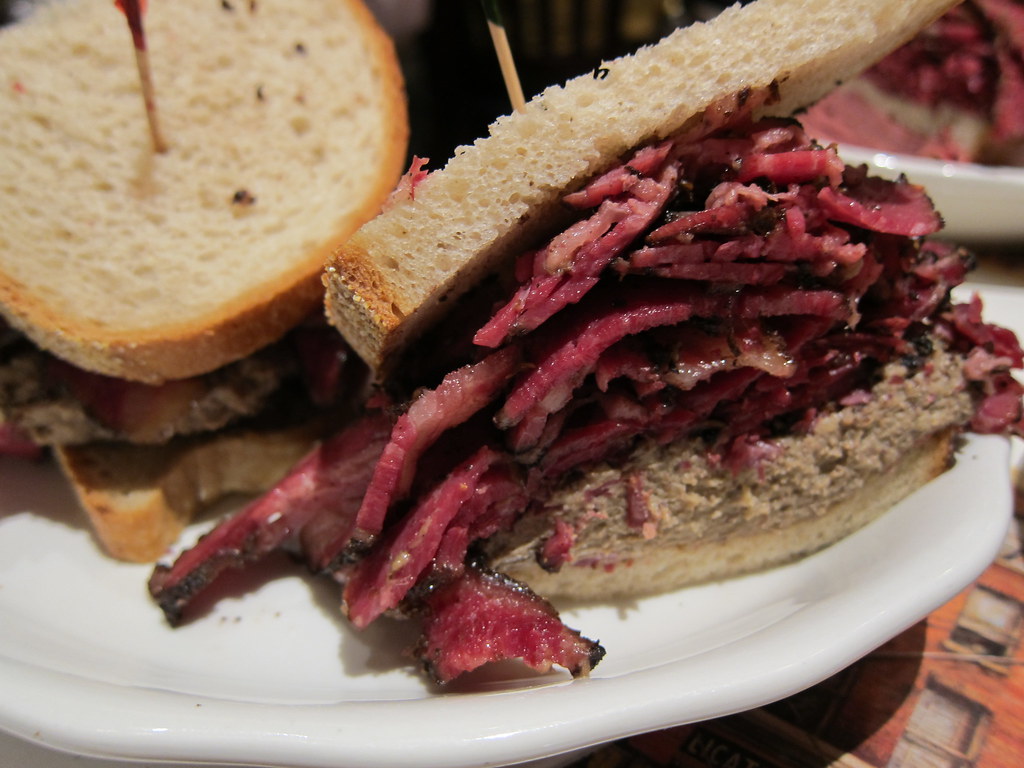
My usual go-to is pastrami on rye slathered with tangy mustard: Perfection in a sandwich. But I was inspired by the TV episode and decided to take it to another level with the addition of chopped liver. Turns out, I still like it simple—the chopped liver made it all so very overwhelming. The chopped liver was distracting me from my beloved pastrami.
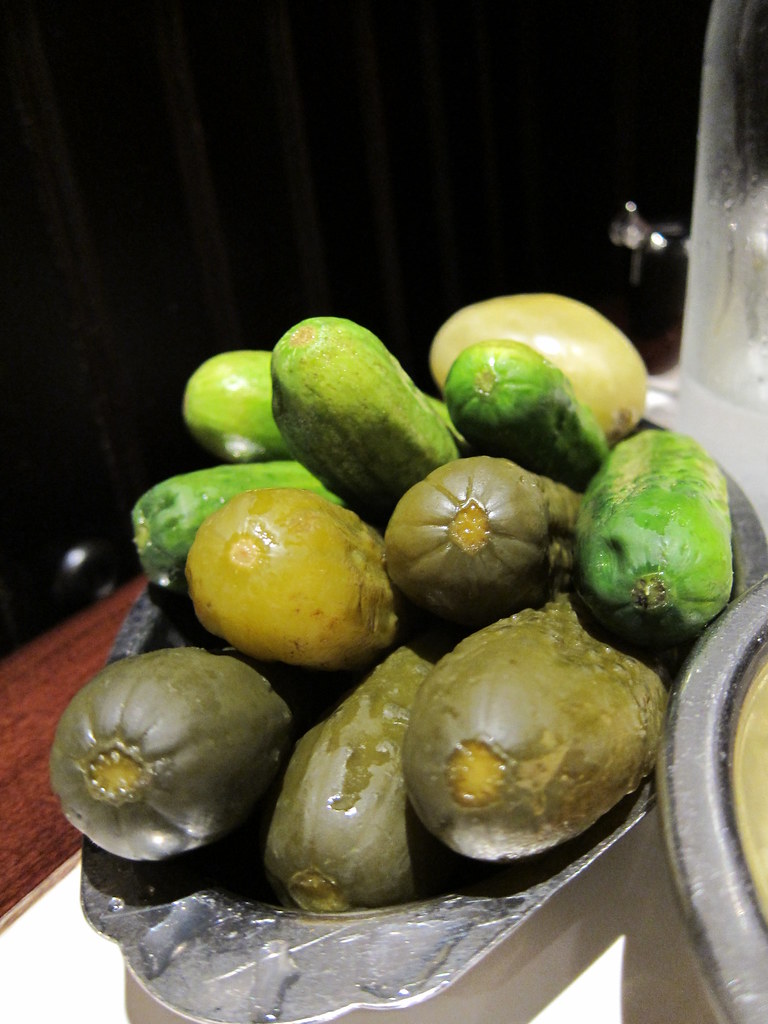
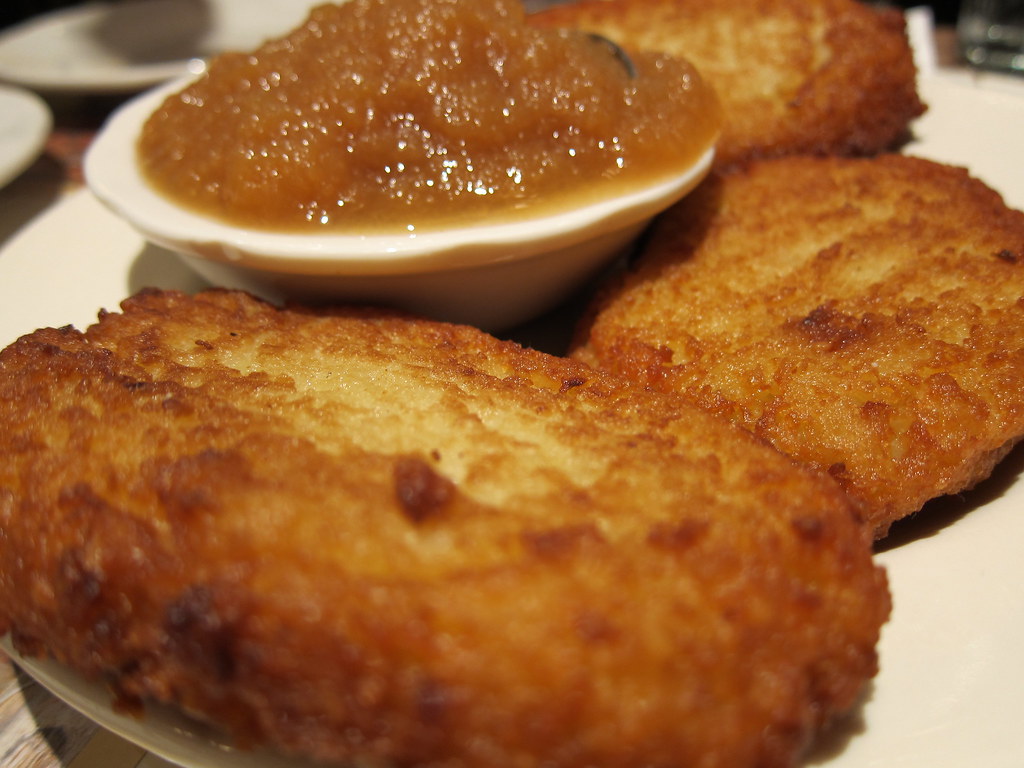
The bucket of refreshingly cold, crispy pickles and pickled tomatoes was casually tossed onto the table by our jovial waitress, soon to be greedily grabbed the moment it landed (the pickles that is, not the waitress). My usual sides were included: an order of some of the best potato pancakes in New York, potato salad, and a rootbeer.

Unable to decide, Alex went for the gold and ordered a triple decker sandwich of pastrami, bologne and coleslaw; each layer separated by a padding of rye bread. MADNESS! My brother ordered The Heartattack. More madness. Is this how King Leonidas of Sparta ate? “Madness? THIS IS PASTRAMI!”
2nd Avenue Deli. Still my favorite Jewish Delicatessen for pastrami in all of New York. See here and here for previous posts about this spot.
2nd Ave Deli
162 E 33rd St
New York, NY 10016
Tel: +1 (212) 689-9000
Monday, July 19, 2010
The Sifty Fifty

Yet another iPhone app for foodies is out. The Scoop is a free New York iPhone app by the New York Times. Included
in this app is NYTimes restaurant critic, Sam Sifton’s “current 50 favorite
restaurants in New York.” The list
will be updated periodically and also includes recommended bars (“The Top
Shelf”).
I would have been more excited for an app like “Bruni’s
Best” or “Frank’s Fifty” or “Reservations with Ruth.” I’m not a big Sifton fan and if you can’t tell, I still miss
Frank Bruni and Ruth Reichl big time.


A look at Sifton's current list of favorites isn’t making me any warmer towards him either:
Babbo
Balthazar
Baoguette
Bar Americain
Bar Boulud
Bereket Turkish Kebab House
Blue Smoke
Cabo Rojo
Casa Lever
Casa Mono
Chez Napoleon
Del Posto
Devi
Diner
Eleven Madison Park
Elio’s
Fatty ’Cue
Grand Sichuan
Eastern
Hill
Country Barbecue Market
Il Cantinori
Imperial Palace
Ippudo
Keens Steakhouse
La Caridad 78
La Grenouille
Landmarc
Le Bernardin
Locanda Verde
Madangsui
Marea
Minetta Tavern
Momofuku Ssäm Bar
Motorino
Great
N.Y. Noodletown
Ouest
Pam Real Thai Food
Peasant
Peking Duck House
Per Se
Prime Meats
Prune
Purple Yam
Purple Yam
Red Cat
The River Café
Shun Lee Palace
Strip House
Sushi Yasuda
Tanoreen
Veselka
The Waverly Inn
A list of favorites all boils down to personal taste, so I
won’t bash too hard on Sifton's top 50 that I mostly disagree with.
But I will bash Sifton a writer. He isn’t magical, and yes.. magic is exactly what I expect. ex NYT critics Reichl and Bruni, in their own styles, weave masterpieces
out of each and every review.
Whether or not I end up agreeing with their conclusions, they made food
critiquing an art. They helped
make the NYTimes’ Dining & Wine section the standard for restaurant critiquing in the English speaking world.

Compare:
Sam Sifton isn’t terrible nor do I hate the guy.
I just get frustrated how he observes and writes like any ol’ food writer.. blogger quality
even. There are times when I feel
more inspired by articles on Serious Eats than NYT’s (not that Serious Eats
writers are bad--in fact, I love them! Again, I just
hold NYT to god-like standards). I
don’t like how he’s so accessible with his food and exercise journals or
interactivity with readers on social networks. Save that stuff for an autobiography or his post-restaurant
critic era. I’m old fashioned and
I only want to hear about the food!
Clearly, I like to put old school NYT’s writers on pedestals.
Friday, July 9, 2010
Gastronommy TV: Cookyn With Mervyn [video]
As promised, here is the full video of Cookyn With Mervyn. The video was filmed, produced and edited by Mike Foong. Unfortunately, there were some audio issues during the cooking process so instead of our original intention of sharing some of the recipes, we'll be telling you what the course is about instead!
See here for the original entry about Cookyn with Mervyn.
"My friends Leada and Regina invited me to a group cooking class here in Singapore: Cookyn with Mervyn. Mervyn taught us tips, tricks and recipes for churroz, prawn cerviche, squid ink paella, chorizo & potatoes and red sangria. SGD$90 for a full course meal with friends."
Cookyn with Mervyn
273 Thomson Road #04-01 Novena Gardens
(Lift Lobby B)
Singapore 307644
Tel: +65 9099 6231
info@cookyn-with-mervyn.com
See here for the original entry about Cookyn with Mervyn.
"My friends Leada and Regina invited me to a group cooking class here in Singapore: Cookyn with Mervyn. Mervyn taught us tips, tricks and recipes for churroz, prawn cerviche, squid ink paella, chorizo & potatoes and red sangria. SGD$90 for a full course meal with friends."
Cookyn with Mervyn
273 Thomson Road #04-01 Novena Gardens
(Lift Lobby B)
Singapore 307644
Tel: +65 9099 6231
info@cookyn-with-mervyn.com
Tuesday, July 6, 2010
MEATOPIA and other upcoming Summer NY Food Events!
MEATOPIA.

The event is being hosted by [controversial, free loading] writer Josh Ozersky and Good Beer's Jimmy Carbone. Chefs to look out for include Fatty 'Cue's Robbie Richter and Convivo's Michael White. Meat suppliers include New York's favorite Pat LaFrieda Meats and Flying Pigs Farm, and part of the proceeds will go to the selected charities Just Foods and Slow Food NYC. The event will include a BBQ competition in which attendees will get to vote on their favorite piece of flesh.
What: MEATOPIA - BBQ NYC
When: Sunday, July 11, 2010 (raindate July 18, 2010) / 11:30am - 4:30pm
Where: Governors Island, New York Harbour
Cost: FREE entry, but if you want to taste it will cost you anywhere between $25-$150, depending on how many tastings you're going for.
Menu: Meatopia's Menu
ASIAN FEASTIVAL
Queens, New York is finally getting its well-deserved spotlight this September. Queens is home to some of the best Asian cuisine in all of New York. As wonderful as most cuisines are in Manhattan, even Chinatown and Koreatown have nothing on Queens in terms of value for money, specialty dishes and quality.
Asian Feastival intends to show some of the best of Queens in a series of tastings, bike tours (awesome idea!), culinary lessons and book signings. Attendees will learn where to find the best Asian farmers markets, how to understand Southeast Asian cuisine in NY, and the secrets of rice. Chef appearances include Pichet Ong (Sweet Spot), Lee Ang Wong (Top Chef) and Eddie Huang (Baohaus).
Asian Feastival is still constructing the rest of its program, so keep up to date with their growing list of restaurants and guest appearances on their website.
What: ASIAN FEASTIVAL
When: September 6, 2010 / 12:00pm - 5:00pm
Where: Sheraton LaGuardia East Hotel (135-20 39th Ave, Queens)
Cost: $55 advance, $60 door
Program: Asian Feastival's Schedule
Program: Asian Feastival's Schedule
Unfortunately, I will not be able to attend either event, but if any of you end up attending... please update me with your experiences here on Gastronommy.com or on Gastronommy's Facebook Page!
Thanks Jenn Joo and Mrs. Won for the leads.
Moving out of New York
It has been quiet on Gastronommy and I apologize! Sadly, an entire week was dedicated to packing up my K-town apartment and preparing my move to Singapore. I now have one free week left in New York and I'm living it to the fullest. Since setting foot back in JFK Airport New York, I've been doing my duty as a professional eater. I promise updates about the past 2-3 weeks soon! As for why I'm moving to Singapore, details to come on that once I settle down there.
 The New York list includes Russ & Daughters bagel with lox, 2nd Avenue Deli's pastrami and chopped liver on rye, Shake Shack's Shack Burger and cheese fries, Schnippers' honey milkshake and sloppy joe, Korean gems in Flushing, fancy subs from No.7 Subs, Brooklyn's latin truck vendors at Red Hook Ballfields, Clinton Street Bakery's fabulous blueberry pancakes and more.

And yes, I've gained weight. There is no way to maintain such an extravagant diet and not gain weight. Not according to my genes anyway. Warning: eat like this at your own risk!
In the meantime, see Gastronommy's Facebook Page for some photos of the NOMSrades I've been nomming with. Tomorrow, I'll be filming another Gastronommy TV episode at a special location in Soho, NY. Then followed by a late dinner at Mario Batali's Babbo. It has been an exciting week so far.
Caracas Arepas Bar, New York
In the meantime, see Gastronommy's Facebook Page for some photos of the NOMSrades I've been nomming with. Tomorrow, I'll be filming another Gastronommy TV episode at a special location in Soho, NY. Then followed by a late dinner at Mario Batali's Babbo. It has been an exciting week so far.
Tuesday, June 22, 2010
What to Eat in Singapore: For the First Time Visitor (Part I)
(Read here for Best Singapore Crabs)
(Read here for Best Brunch Spots in Singapore)
 But with friends from all over the world coming to visit Singapore and instead of retyping emails over and over again about my current favorite food stalls, I shall publish my recommended Shiok Eats list for the First Time Visitor.
(Read here for Best Brunch Spots in Singapore)
I was going to wait at least a few more months before making any posts specifically about Singapore dining. I wanted to make sure I tried out every worthwhile eatery in every corner of this Lion City before putting it in print (it's a small country, it almost seemed possible).

In great detail, I can vividly recall the first time I tried dishes that were uniquely Singapore years ago. My first bakuhteh, my first laksa, my first hokkien mee, my first roti prata, my first rojak, my first chili crab, etc.. I also vividly remember my first time going to Mambo Jambo at Zouk, but that's another topic not appropriate for a food blog...(I highly recommend it for my American compadres if you want a glimpse of a bizarre Asian dance party unlike one you've ever seen before!)
I'll save all the details on particular food visits and condense my recommendations to a list for easy viewing. I'm sure this list will evolve and grow over time as I spend more time in Singapore. In the meantime, the first timer to Singapore can't go wrong with these recommendations. I guarantee the food won't disappoint:
Friday, June 18, 2010
Food Diary: Last two weeks in the little red dot (Singapore)
Hawker food included: hokkien char mee (black), hokkien hae mee (white), pontian wonton noodles, Portuguese egg tarts
Restaurants visited: Tippling Club, Mellben Seafood, TWG, Tanjong Beach Club

Photo loaded entry! Click to read full post.
Restaurants visited: Tippling Club, Mellben Seafood, TWG, Tanjong Beach Club
Photo loaded entry! Click to read full post.
Monday, June 7, 2010
Gastronommy TV: Sneak Peek [video]
Last month, I mentioned Cookyn with Mervyn and an upcoming video. Here's a sneak peek of the intro! Let us know what you think!
Friday, June 4, 2010
Food Diary: Home cooking (Singapore)
Thurs 3 June 2010

Dinner, Singapore
NOMsrades: Brandon, Adrian, Kimmy, Nikki, Warren, Shupe, Mommy Mah

paella: saffron, chorizo de bilbao, glass prawns, cockles
Long overdue, made dinner for the Mah's! Getting the proper Spanish ingredients are tough and expensive to get in Singapore, it seems. Instead, I replaced a lot of ingredients, such as basmati for the paella (thanks to Mervyn for that idea).
I completely forgot to take photos. I was a bit rushed on the whole thing since I had a late start. Luckily, Brandon Lee took some photos of the paella on his iPhone. Resulting Menu: ricotta cheese dip (not so Spanish, but I didn't have time for my manchego & jamon creation--it'll be for lunch tomorrow), prawn ceviche, seafood & chorizo paella, and roast chorizo & potatoes with thyme. Kimberly ended up taking over for dessert with a peach and strawberry crumble--thank goodness because she's a brilliant baker and I'm not. My original menu ended up not taking effect... another time, I guess!
Everything turned out to be edible enough, considering it was my first home attempt at paella. I just wish I had a cast iron pan so I could get more of that nice thick bottom layer of crispy paella. The main dish was inspired by Ruth Reichl's paella recipe with some personal twists. It was all gone by the end of the meal, so either it wasn't so bad or they were just starved by the time dinner was served.
Wild Spot Prawn Ceviche with Wild Rocket
(or salmon, Hokkaido scallops, fresh white fish)
adapted from Cookyn with Mervyn
18 spot prawns, peeled and tail intact
2 tbls shallots, chopped
2 tbls jalapeno/green chili, chopped
2 tbls extra virgin olive oil
1 sprig coriander, chopped finely
1 lemon, juiced
2 large limes, juiced
50gm wild rocket
1. Mix all ingredients (except prawns and wild rocket) and season with salt and pepper.
2. Pour marinade over the spot prawns and leave for 15 minutes (longer for scallops).
3. Serve marinated prawns with wild rocket and a final crack of salt and pepper.
Wednesday, June 2, 2010
Food Diary: Adam Road Food Centre (Singapore)
Monday 31 May 2010
11:30pm Singapore
NOMs Comrade: Adrian
I'm embarrassed to post the hour at which we ate... Late night supper! I'm currently compiling a "Singapore Eats" list and want to get it posted by next week. There are a bunch of places I still need to revisit for better photos or a re-taste to double check my choice. There are only so many meals in a day, so lately there have been a number of extra visits late into the night. The things I'm starting to do for this site. Ridiculous.
Unfortunately, the nasi lemak stall I was looking for wasn't even open! ARGH.
So to console my poor self, I ate something else. :)
 Noo Cheng Adam Road Prawn Noodles: I'm a noodle kind of girl. I tried Noo Cheng's prawn noodles two weeks ago. It was good, but definitely not the best I've had in Singapore. Adam Road seems to be better for Malay food than anything else, but I wasn't in the mood for it.


11:30pm Singapore
NOMs Comrade: Adrian
I'm embarrassed to post the hour at which we ate... Late night supper! I'm currently compiling a "Singapore Eats" list and want to get it posted by next week. There are a bunch of places I still need to revisit for better photos or a re-taste to double check my choice. There are only so many meals in a day, so lately there have been a number of extra visits late into the night. The things I'm starting to do for this site. Ridiculous.
Unfortunately, the nasi lemak stall I was looking for wasn't even open! ARGH.
So to console my poor self, I ate something else. :)


I had the pork rib noodles, this time with rice noodles (SGD$3). I could not be bothered with peeling otherwise mediocre prawns.

Coupled with teh tarik (unfortunately, I forget the stall name)

Tek Kee Hot & Cold Desserts: Disgusting pigs we are, we even finished off with a late night dessert. But I felt less guilty once I noticed that there was a constant lineup of 4-5 people in front of this stall at 1am. Fellow oinkers.

My first ching teng. The numerous press articles posted on the stall highlighted their ching teng and its relative cheapness compared to other stalls. Still, even at SGD$1.50, it's really just a bowl of shaved ice. Nice profit margins, I imagine.

It's much more simple and modest than other versions of shaved iced I've had (usually drowned in condensed milk, corn, jelly and other goodies). Still, I enjoyed the bits of dried longan, ginko nuts, clear jelly, and rock sugar flavors. Looks like I'll have to add ching teng to my Singapore hunting list.
Adam Road Food Centre
2 Adam Road
Singapore, Singapore
Subscribe to:
Posts (Atom)
LinkWithin
